
Blog Posts
Steel vs. Fiberglass Entry Doors: Which Is Better for a Michigan Home? (2026)
Quick Answer
Fiberglass is often a good front-door choice when you want a stainable wood look and a skin that will not rust. Steel can offer a lower upfront price and a crisp painted finish. Both can make secure, energy-efficient entries when the complete system is well specified and installed. Compare exposure, finish maintenance, glass, frame construction and the installed quote—not skin material alone.
The Real Difference Is Under the Skin
Many residential steel and fiberglass entry doors combine an insulating core with an outer skin. Edges, rails, frames, thresholds, glass and weatherseals also differ by product and affect durability. Check the complete system, not just a cutaway of the slab.
A steel entry door is a galvanized steel face bonded to a polyurethane foam core, with a wood or composite frame running around the perimeter. The number that matters is the gauge, and it is counterintuitive: lower is thicker. Builder-grade 24-gauge steel is thin enough that a bike handlebar leaves a permanent dent. A 20-gauge door is meaningfully tougher and worth asking for.
Fiberglass doors use a molded fiberglass skin and may offer smooth or woodgrain surfaces. Internal edge and rail materials vary by line; do not assume every fiberglass slab has all-composite construction. Compare the selected Therma-Tru series, frame and finish together.
Both insulated steel and fiberglass units can provide good thermal performance. Use NFRC whole-product ratings for the exact door size and glass configuration. A center-of-slab R-value does not describe the performance of the whole installed entry.
Steel vs. Fiberglass at a Glance
| Factor | Steel | Fiberglass |
|---|---|---|
| Typical installed cost (36″ single) | $700 – $2,000 | $1,800 – $5,000+ |
| Service life | Depends on product, exposure and care | Depends on product, exposure and care |
| Dents | Can dent; repair options vary | Resists dents; can crack or be damaged |
| Rust | Yes, once the paint is breached | Fiberglass skin does not rust; hardware may corrode |
| Wood-grain look | Painted finishes only | Convincing stainable grain |
| Moisture and deicing-salt exposure | Vulnerable at any chip or scratch | Skin resists corrosion; protect other components |
| Interior condensation in deep cold | Depends on surface temperature and indoor humidity | Still possible at glass, edges or other cold surfaces |
| Maintenance | Touch up scratches promptly | Maintain the selected finish as directed |
| Best useDEPENDS | Side, basement, garage, rental entries | Front doors and exposed openings |
Why Michigan Is Harder on an Entry Door Than the Brochure Assumes
For Southwest Michigan entries, evaluate wind-driven rain, snow, temperature changes and sun exposure at the actual opening. These conditions affect the frame, finish and installation as well as the slab material.
Temperature changes. Seasonal movement can affect alignment and weatherseals. A well-supported, properly fitted frame and compatible system components matter with either material.
Thermal conductivity. This is the big one. Steel conducts heat hundreds of times more readily than fiberglass. Even with a foam core, the steel skin and edges act as a thermal bridge, which is why a steel door feels cold to the touch in January when a fiberglass door next to it does not.
Moisture and deicing salt. Lake Michigan is freshwater; lakeshore exposure should not be described as ocean salt air. Wind-driven moisture is still relevant, and deicing salt near an entry can damage exposed metal. Maintain coatings and hardware according to the manufacturer’s instructions.
Direction of exposure. A west-facing door in Bridgman or South Haven takes wind-driven rain and lake-effect snow straight to the slab. A south-facing door takes the UV. A north entry under a deep covered porch, by contrast, lives an easy life — and that is exactly the opening where a steel door makes financial sense.
The Condensation Problem Nobody Warns You About
Condensation forms when an interior surface is cold enough for moisture in the indoor air to condense. It can appear on either door type, especially at glass or other cold parts of the assembly. Persistent moisture deserves attention to humidity, air leaks and installation details.
Check indoor humidity and ventilation, weatherseals and possible air leakage. The humidity level that avoids condensation changes with outdoor temperature and the product’s surface temperatures. Switching to fiberglass alone does not guarantee that condensation will stop.
The Dent Test
Steel can dent from impacts. Depending on severity and finish, a repair may be possible, but a damaged slab can require replacement. Consider where bikes, furniture or a swinging storm door could strike the entry.
Fiberglass resists many everyday dents, but it is not damage-proof and may crack under impact. Compare the specific product’s construction and repair guidance before choosing on durability alone.
A Word About Storm Doors
A storm door can trap heat against an entry, particularly with dark finishes and direct sun. Check both manufacturers’ instructions and warranty restrictions for the exact combination. Ventilation, finish color and exposure affect whether that installation is appropriate.
If you want a dark front door — and dark front doors are having a long moment — either skip the storm door, choose a ventilating or partial-view storm, or confirm the specific color and storm-door combination is covered before you order. This is also worth reading about if you are planning a custom color; we cover the finish side of it in our guide to custom front door paint and stain options.
Where Steel Still Wins
Fiberglass is not the answer to every opening, and pretending otherwise would waste your money. Steel is the right call more often than the internet suggests.
✓ Choose Steel If
- The opening is protected by a porch, overhang, or breezeway
- It is a garage service door, side entry, or basement door
- The selected assembly meets the requirements for a house-to-garage opening; have the installer confirm suitability
- The door will be painted a light or mid-tone color
- It is a rental or a flip and you want the lowest cost per secure year
- You want a dead-flat modern slab with no grain at all
✓ Choose Fiberglass If
- It is the front door guests actually walk up to
- The opening faces west or south, or takes weather head-on
- You are within a few miles of the lakeshore
- You want a stained wood look without maintaining real wood
- You are staying in the home ten or more years
- You are adding sidelites or a transom and want the whole unit to age evenly
What About Real Wood?
Wood is still the best-looking entry door made, and on a historic home in South Haven, Niles, or Marshall, a fiberglass door can look wrong in a way that is hard to articulate but easy to see. A true wood door has heft and a depth of grain that molded fiberglass gets close to but never quite equals.
Wood can be a good fit for a protected entry when its appearance is the priority. Its finish needs regular inspection and renewal appropriate to exposure. Fiberglass also requires finish care: see the Therma-Tru finishing and topcoat instructions. Our Therma-Tru review explains the broader buying tradeoffs.
What It Actually Costs Installed in Southwest Michigan
Use these existing ranges as preliminary planning allowances for a standard single entry, not current quotes. Ask which frame, glass, hardware, finishing and installation tasks are included; concealed repairs and unusual sizes can change the price.
- Basic steel prehung, no glass$900 – $1,500
- Steel with half-lite glass$1,100 – $2,000
- Painted smooth fiberglass$1,800 – $3,000
- Stainable wood-grain fiberglass$2,500 – $4,000
- Premium fiberglass (deep grain, thicker slab)$3,500 – $6,500
- Add two sidelites+$1,200 – $3,500
- Add a transom above+$600 – $1,800
Compare total ownership cost without assuming a fixed lifespan. Add the quoted installation price, likely finish maintenance and any repair needs. A $1,000 door purchased twice costs $2,000 before additional expenses; that arithmetic alone does not prove it costs more than a $2,800 door.
The Mistake That Ruins Either Door
Installation can outweigh a material upgrade. An out-of-square or poorly sealed opening can cause operation and water-management problems with either slab. Budget for correcting the opening and following the manufacturer’s installation instructions before spending more on decorative features.
Four questions to ask whoever is installing your door:
- How will the sill be supported, flashed and drained for this opening and door system?
- Which fasteners, locations and framing connections does this manufacturer require?
- How do the lock, strike, hinges, slab and frame work together as a security system?
- Which sealants and insulation are compatible with the door and opening?
If you want to go deeper on style, glass, and configuration before you shop, start with our overview of choosing the right door for your home.
Compare Steel and Fiberglass Side by Side
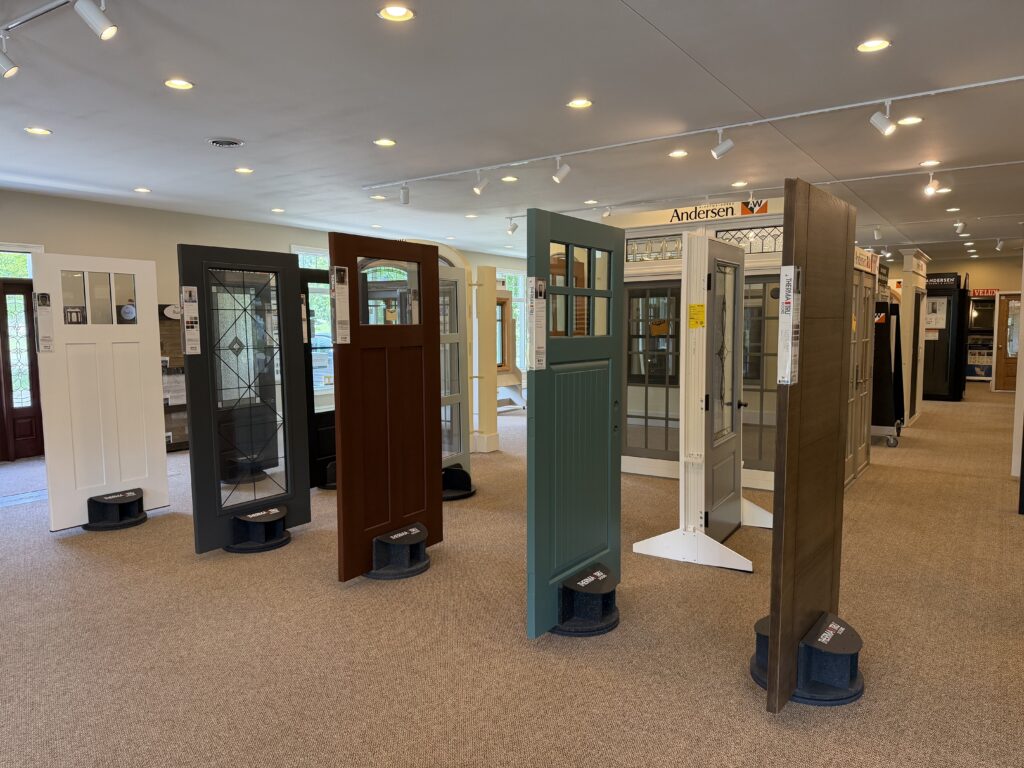
Photos flatten the difference. Grain depth, panel profile, and how a finish reads in daylight are all things you have to see in person. Stop into any of our eight Southwest Michigan showrooms and put your hands on both.