
Blog Posts
Kitchen Cabinet Storage: Drawers vs. Roll-Outs vs. Shelves
Quick answer
Choose drawers for direct access to everyday items, roll-out trays for slide-out storage behind cabinet doors, and stationary shelves where the contents are easy to see and reach. A useful kitchen usually combines them. The right choice depends on what you store, the usable space inside the cabinet, and whether doors and drawers can open fully. Before ordering, check your largest cookware, appliance specifications, and the space needed to stand in front of an open cabinet.
A kitchen can have plenty of cabinets and still leave you moving three things to reach one pot. Storage planning starts with those everyday frustrations. A deep drawer, a roll-out tray, and an adjustable shelf may occupy a similar cabinet footprint, but each changes how you retrieve and put away what is inside.
For a Southwest Michigan kitchen remodel, decide where your belongings will go while you plan the cabinet layout. Leaving organization until after the order can limit your options.
Start with what needs a home
Group your kitchen items by use: preparation, cooking, baking, serving, food storage, and cleanup. Then note the pieces that are awkward to store now.
- Everyday dishes: Count the stacks and measure your largest dinner plate or bowl.
- Cookware: Include handles, lids, and the height of nested pots.
- Baking equipment: Measure your tallest sheet pan and longest cutting board if you want vertical storage.
- Small appliances: Record the full stored size, including attachments that need to stay with the appliance.
- Food containers: Decide whether lids will sit beside the containers or in a separate compartment.
Mark what you use daily and who needs to reach it. This gives the designer a clearer starting point than a request for “more storage.”
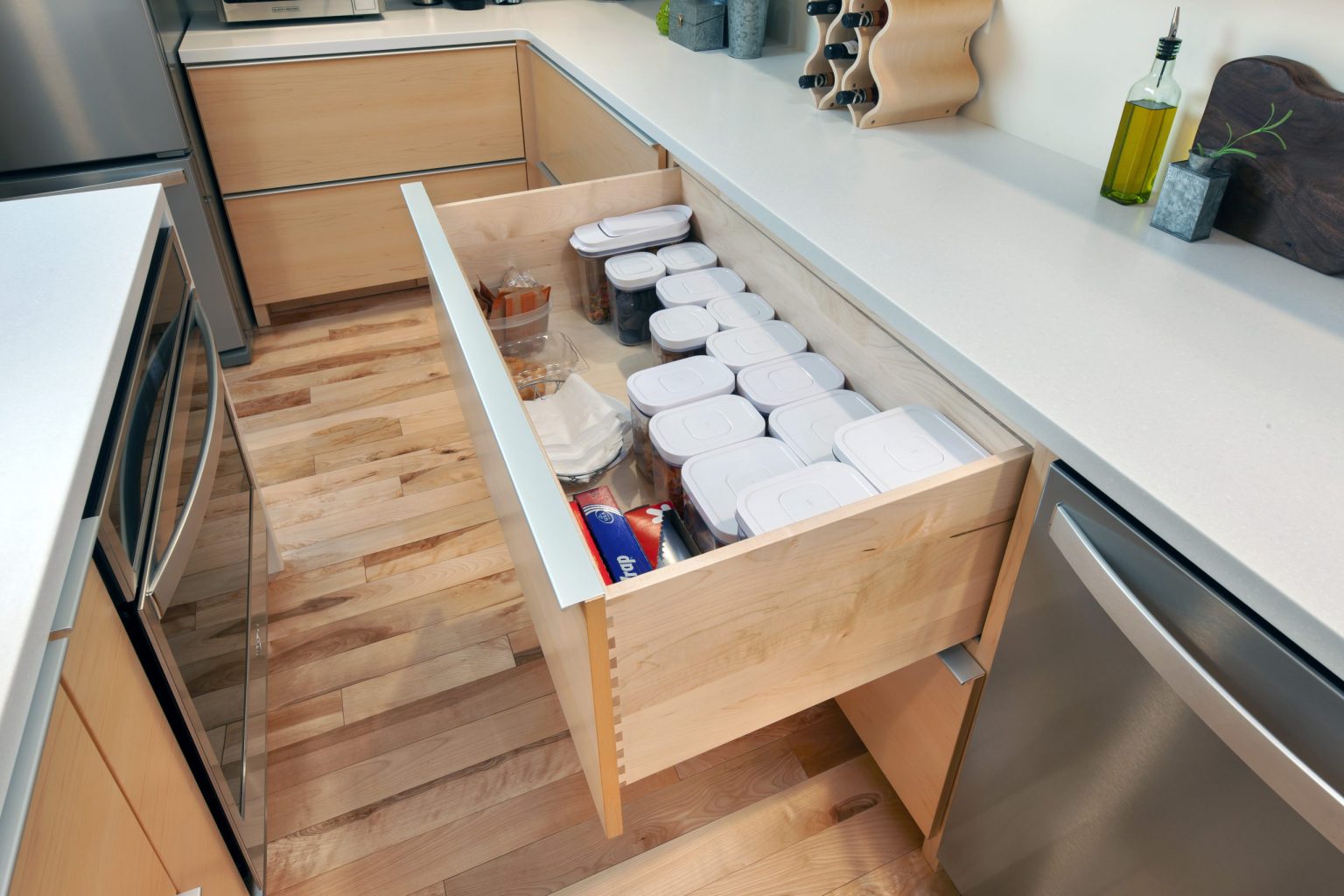
Drawers, roll-out trays, or shelves?
Drawers: direct access from the front
A drawer opens with its front, so you can reach the contents without opening a separate cabinet door first. Shallow drawers suit utensils and smaller tools; deeper configurations can hold cookware, containers, or dishes when the dimensions and hardware are appropriate.
Organization still matters. A deep drawer can become a stack of mixed lids unless you plan dividers or separate compartments. KraftMaid’s Pegged Drawer Organizer, for example, uses repositionable pegs for dishes and cookware. Confirm that the insert fits the exact drawer specified in your plan.
Check: Usable interior dimensions, extension, weight limits, and how comfortably each household member can reach the contents.
Roll-out trays: moving storage behind doors
A roll-out tray sits inside a cabinet and slides forward after you open the door or doors. It can make items at the back easier to inspect and retrieve while keeping a door-front appearance.
That opening sequence matters. Try it in a showroom: open the doors far enough, pull out the tray, lift an item, and put everything away. Confirm whether one or both doors must open and whether nearby hardware interferes.
KraftMaid’s Deluxe Dovetailed Roll-Out Trays have adjustable tray locations and full-extension runners. Availability and installation requirements depend on the cabinet and kit.
Check: Door clearance, tray spacing, mounting requirements, and the height available above each tray.
Stationary shelves: simple storage with fewer moving parts
Shelves can work well where you can see the contents and remove them without rearranging everything in front. Adjustable shelves let you change the spacing for taller objects, within the cabinet’s available adjustment positions.
Consider them for shallow storage, serving pieces, or items you use less often. A deep base shelf deserves a closer test: can you retrieve the piece at the back comfortably, and will it actually stay there?
Check: Shelf depth, opening size, load limits, and the number of items you must move to reach the back.
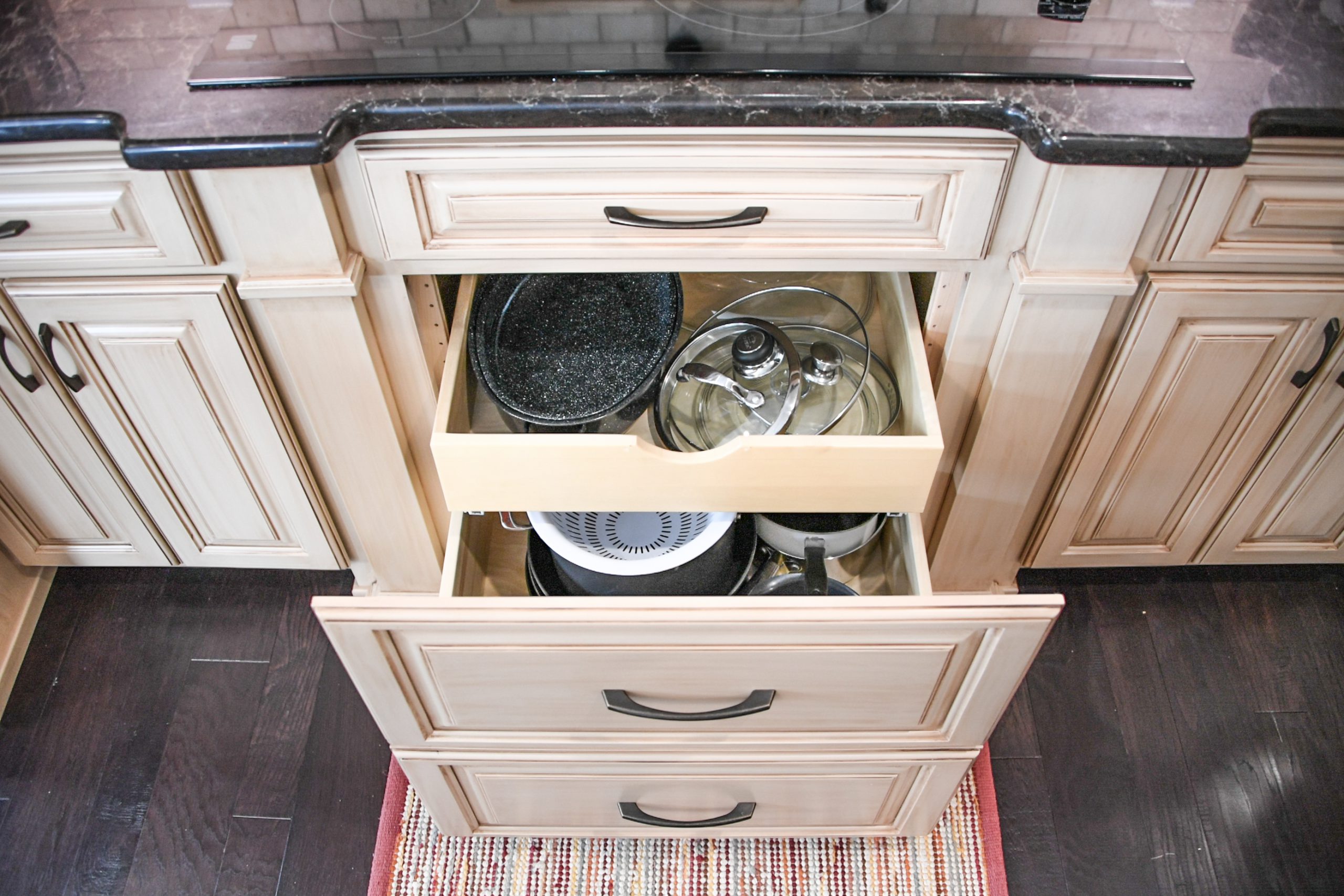
Measure the usable space, not just the cabinet width
The size on a cabinet plan describes the cabinet, not necessarily the space available for your cookware. Drawer sides, runners, trays, face frames, hinges, and organizers all affect the fit.
For example, KraftMaid lists its ROT30.BPPSO pots-and-pans organizer for a 30-inch-wide cabinet, but the listed tray width is 25⅝ inches. That specific product illustrates why cabinet width alone cannot confirm whether your belongings will fit.
- Measure the object as stored. Include a pot handle, lid knob, appliance attachment, or the full height of a stack.
- Confirm the clear opening. Ask for the usable drawer or tray width and depth, plus the clearance above the stored item. A tall drawer front does not establish interior height.
- Allow for the organizer. Dividers and inserts occupy space. Confirm the remaining compartments before choosing them.
- Check the loaded system. Ask for the applicable load rating and whether it includes the tray, insert, or other components.
Bring rough room measurements and photos for the initial conversation. KraftMaid’s kitchen measuring guide also calls for openings, obstructions, and utility locations. Final measurements and product compatibility should be confirmed before ordering.
Test the layout with everything open
A closed-cabinet drawing can hide everyday conflicts. Review these situations with your designer:
- Unloading the dishwasher: Can the dish drawer open while the dishwasher door is down, with somewhere for you to stand?
- Cooking: Does the cookware drawer clear the oven handle, an adjacent pull, and the island opposite it?
- Working at a corner: Can adjacent doors and drawers open without hitting each other? Keep the filler or clearance pieces required by the selected layout.
- Storage below appliances: Confirm cooktop installation requirements before planning a drawer beneath it. Use the exact appliance model’s instructions.
- Under the sink: Account for the sink bowl, drain, disposal, supply lines, and any filtration equipment before choosing a pull-out.
Also check how you will lift a heavy appliance from storage to the counter. A slide-out tray brings it forward; it does not answer every lifting or operating-clearance question. Try the proposed motion and discuss your reach needs.
Common cabinet storage questions
Can roll-out trays be added to existing cabinets?
Sometimes. Confirm the cabinet’s construction, dimensions, hinges, opening, and mounting locations against the specific kit. A matching exterior width is not enough. KraftMaid notes that side-by-side installation of its Deluxe Dovetailed Roll-Out Trays requires a center-stile mounting block.
Should every base cabinet have drawers?
No. Start with drawers where direct access solves an everyday problem, then compare shelves, trays, and specialty storage for the remaining contents. Plumbing, appliance requirements, tall objects, and the room layout may call for different configurations.
How should I compare the cost of these options?
Ask your designer to price alternatives for the same cabinet location and intended contents. Include organizers, hardware, and installation. Review the actual difference in usable storage and operation rather than assuming one option always offers better value.
Bring your storage problems to Hannapel
Bring kitchen photos, rough measurements, appliance model numbers, and a short list of the things that never seem to fit. For a South Haven project, ask for Terri Yore, a Kitchen & Bath Designer at our South Haven showroom.
Still deciding which cabinet approach fits the project? Read our semi-custom vs. custom cabinet guide. To work through the layout and storage details, request a design consultation at a Hannapel showroom.