
Blog Posts
Are Custom Closet Systems Worth It? Cost, Options & What Actually Works (2026)
Quick Answer
Custom closet systems are worth considering when the current layout wastes space or makes clothes hard to reach. Double hanging, adjustable shelves and drawers can improve usable storage without enlarging the room. This guide uses $1,200–$2,500 for a reach-in system and $3,000–$8,000 for a walk-in as planning ranges, not quotes. Declutter and count what you need to store first: a new layout cannot solve every shortage of space.
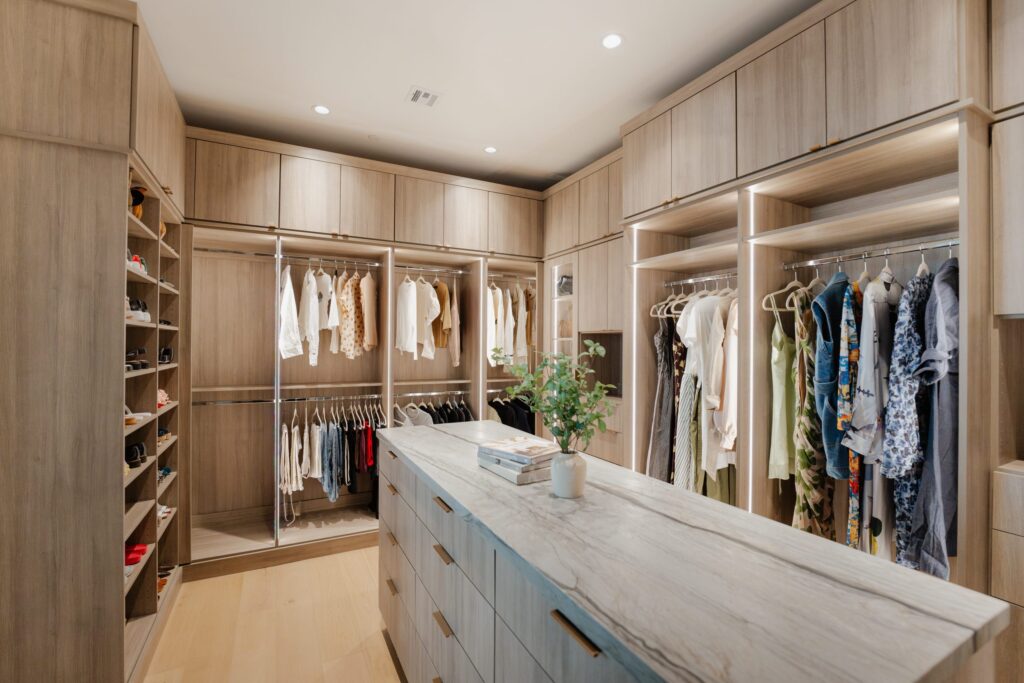
What “Custom Closet System” Actually Means
The phrase covers three genuinely different products at three very different prices, and most of the confusion around closet quotes comes from comparing across tiers without realizing it.
Wire shelving is an economical, ventilated storage option. Gaps can leave marks on folded clothes or let small items tip, while adjustability depends on the system. Its load capacity depends on the product, supports and wall fasteners; follow the manufacturer’s installation requirements rather than assuming drywall alone is sufficient.
Laminate or melamine systems are the mainstream custom closet. Engineered panels with a durable thermally fused surface, cut to your dimensions, with adjustable shelves, drawers, rods, and accessories. This is where most homeowners land, and it is genuinely good value.
Furniture-grade custom cabinetry is built the way kitchen cabinetry is built — plywood boxes, real wood fronts, soft-close hardware, applied molding, integrated lighting. This is the tier where a closet stops reading as storage and starts reading as a room. It is also where our own Dutchmaid custom cabinetry line lives.
The Three Tiers Compared
| Tier | Reach-In Cost | Walk-In Cost | What to check | Best For |
|---|---|---|---|---|
| Wire shelving | $150 – $400 | $400 – $900 | Shelf span, supports and rated load | Utility, linen, basement |
| Laminate systemBEST VALUE | $1,200 – $2,500 | $3,000 – $8,000 | Edge protection, hardware and warranty | Most bedrooms and primary closets |
| Furniture-grade custom | $3,000 – $6,000 | $10,000 – $30,000+ | Construction, finish care and warranty | Primary suites, dressing rooms |
What Custom Closets Cost in 2026
These are preliminary budgeting examples retained from this guide, not verified transaction averages or current quotes. Confirm dimensions, design fees, removal, wall repairs, electrical work, delivery, installation and tax before comparing proposals.
- Reach-in closet, basic system$800 – $1,500
- Reach-in closet with drawers$1,500 – $3,500
- Standard walk-in (roughly 6′ × 8′)$3,000 – $6,000
- Primary walk-in with drawers and glass fronts$6,000 – $15,000
- Dressing room with island$15,000 – $30,000+
- Pantry system$1,500 – $5,000
- Mudroom lockers and bench$2,500 – $8,000
- Garage storage system$2,000 – $8,000
The two variables that swing a quote hardest are drawers and finished ends. Drawers are the most expensive linear foot in any closet — each one is a box, a front, and a pair of slides. Exposed, finished end panels cost more than panels that die into a wall. A design that keeps drawers in one bank and hides its ends will come in meaningfully under one that scatters drawers across three walls.
The Design Decisions That Actually Matter
Finish selection is the fun part and the least important part. These are the choices that determine whether you still like the closet in year five.
Get the hanging ratio right
Double-hang sections — two rods stacked roughly 40 to 42 inches apart, with the top rod around 81 to 84 inches — store twice as many shirts, folded pants, and jackets in the same run of wall. Long-hang, at 66 to 72 inches of clear space, is for dresses, coats, and full-length garments. Most people need far more double-hang and far less long-hang than they assume. Count what you own before you design.
Plan depth around the clothes and doors
About 24 inches is a useful starting point for conventional hanging space, but check actual hanger and garment depth, rod setback and door clearance. Shallower closets may still work with an adapted layout. Measure the clear space before choosing shelving or moving a wall.
Drawers replace a dresser
This is the underrated move. Six drawers inside the closet often eliminates the dresser in the bedroom, which gives back four to six square feet of floor and frees up a wall for something better. When people say a custom closet changed their bedroom, this is usually what they mean.
Shelf spacing
Twelve to fourteen inches between shelves is right for folded clothing. Tighter than that and stacks topple when you pull from the middle. Shoe shelves want 8 to 10 inches, and angling them slightly forward makes the whole wall readable at a glance.
Floating usually beats floor-mounted
Wall-hung systems leave the floor clear, which makes vacuuming trivial, makes the closet feel larger, and lets you slide a hamper or basket underneath later. Floor-based systems are marginally cheaper and marginally sturdier under very heavy loads. For a clothing closet, floating generally wins.
Light it
Good lighting makes shelves and hanging sections easier to use. LED fixtures still need to be suitable for closet installation and placed according to their listing and manufacturer’s instructions. Have an electrician confirm wiring and required separation from stored clothing; low heat does not remove clearance requirements. A motion sensor can be a useful option.
Where Custom Closets Pay Off — and Where They Don’t
✓ Worth It When
- The closet is small and the layout is wasting vertical space
- You rely on a dresser because the closet cannot hold folded clothes
- Two people share one closet
- You are already renovating and the walls are open
- It is a mudroom, pantry, or garage, where organization pays off daily
- You are staying in the home long enough to enjoy it
✗ Think Twice When
- The real issue is volume — declutter first, then design
- You are selling within a year and hoping to recoup the cost
- The closet is a pass-through you barely use
- You want a magazine closet but will not maintain one
- Budget only stretches to a system with no drawers, when drawers are the thing you actually need
Does a Custom Closet Add Home Value?
A well-organized closet may appeal to buyers, but a higher appraisal or recovery of the installation cost is not guaranteed. Choose a budget that makes sense for your daily use and expected time in the home, rather than treating the project as a promised resale return.
Build it because you get dressed in it every single morning. That is the return.
How the Process Works
If you have never done this before, it is less involved than most people expect:
- Design consultation. Free at Hannapel. Bring photos, rough measurements, and an honest inventory — how many long-hang items, how many pairs of shoes, whether you fold or hang jeans.
- Measure. A designer verifies dimensions on site, including the out-of-square walls that most older Michigan homes have.
- Design and revision. You will see a layout and elevations. This is the stage to push back — moving a drawer bank on paper is free.
- Order and build. Confirm the current lead time for the selected system and finish before scheduling removal or installation.
- Installation. A reach-in is often a single day. A large walk-in runs one to three.
One practical tip: schedule installation for a week when you can live out of a laundry basket for a couple of days. Everything comes out of the closet first.
Matching the Rest of the House
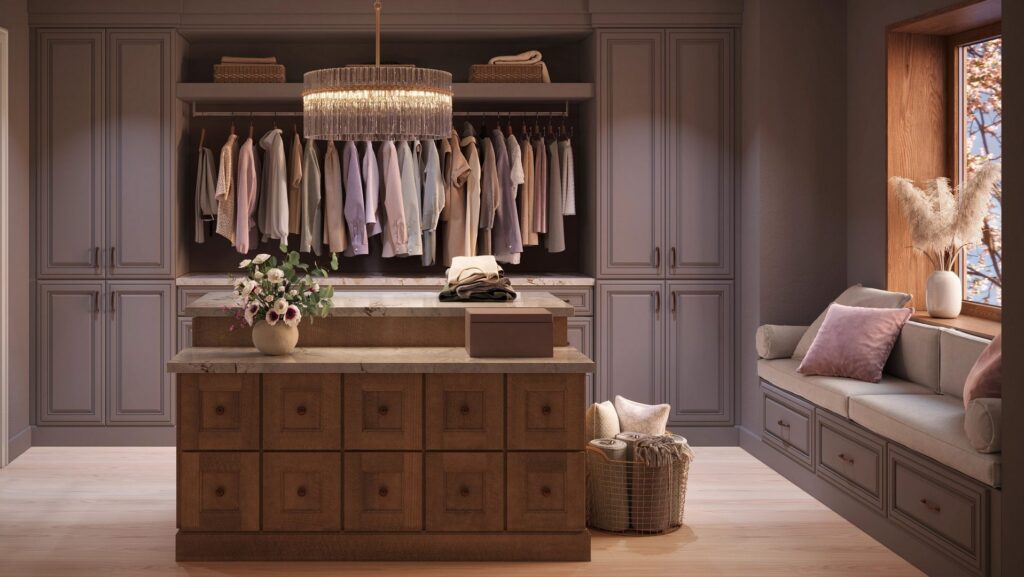
Closets are increasingly specified in the same finishes as kitchen and bath cabinetry, which is a good instinct. A closet in the same door style and stain as the vanity down the hall reads as intentional rather than bolted on. If you are planning multiple rooms, choose the cabinetry line first and design the closet inside it — our overview of popular cabinet door styles is a reasonable place to start narrowing that down.
See Closet Systems in Person
Drawer glides, shelf thickness, and edge banding are things you have to open and close to judge. Visit any of our eight Southwest Michigan showrooms for a free design consultation and we will lay out your actual closet, at your actual dimensions.